Listed and Classified: read the scope.
Compare what UL and the manufacturers say, and keep the exact equipment, document revision and conditions with each statement.
Quick answer
- A specified breaker is one the panel manufacturer lists for its own panel [E2 p.V1-T1-101].
- A UL Classified breaker is made by a different company and has been evaluated by UL for use in place of specified breakers. That evaluation covers only the panels named on the compatibility list supplied with the breaker, and systems up to 120/240 V with no more than 10 kA available short-circuit current [U1 items 97–99] [E2 p.V1-T1-101].
- A breaker can be both UL Classified and UL Listed [U1 item 98] [S6 PDF p.39].
- 01
Record the label
Keep the complete panel identifier, breaker-type list, date and ratings together. Q7
- 02
Read the exact document
Keep the maker, document revision and original page with the record. E1
- 03
Retain conditions and conflicts
Record the printed limits and the panel maker’s separate statement. Q1
- 04
Bring the references to an electrician
A document search does not decide what may be installed. S10
Original drawing and source annotations
The original drawing is schematic, not a product label, field measurement or installation instruction.
Open the original full-size SVG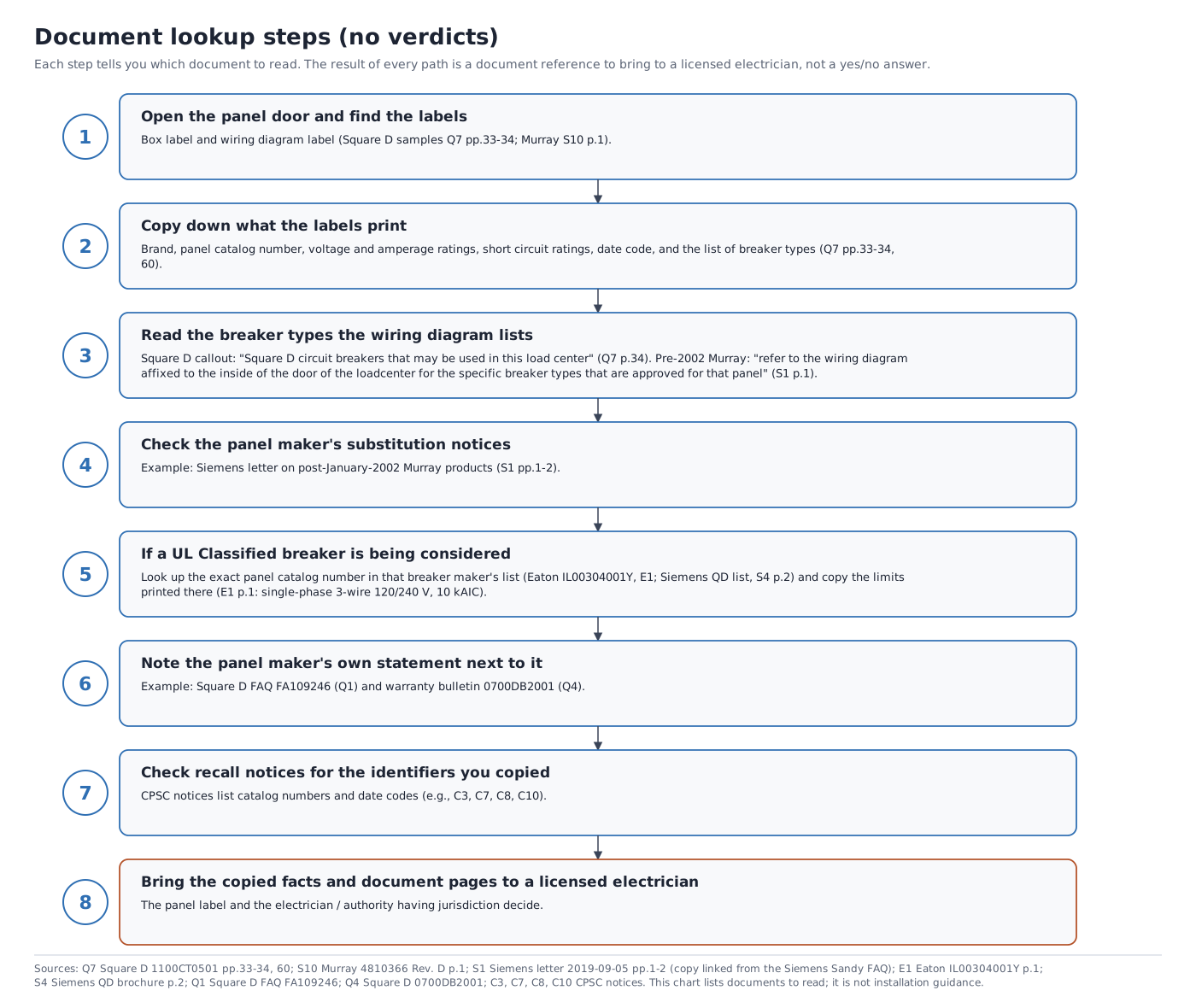
The panel label and the electrician / authority having jurisdiction decide.
Sources: Q7 Square D 1100CT0501 pp.33-34, 60; S10 Murray 4810366 Rev. D p.1; S1 Siemens letter 2019-09-05 pp.1-2 (copy linked from the Siemens Sandy FAQ); E1 Eaton IL00304001Y p.1;
S4 Siemens QD brochure p.2; Q1 Square D FAQ FA109246; Q4 Square D 0700DB2001; C3, C7, C8, C10 CPSC notices. This chart lists documents to read; it is not installation guidance.
Three terms, defined by the documents
| Term | What the source says | Source |
|---|---|---|
| Specified breaker | Breakers the panelboard manufacturer lists for use in a particular panel; manufacturers typically specify only their own | [E2 p.V1-T1-101] [E4 p.1] |
| Listed breaker | Listing is by an independent third party such as UL | [E2 p.V1-T1-101] [E4 p.1] |
| UL Classified breaker | Eaton white paper: "A circuit breaker that UL considers suitable for use in place of a specified circuit breaker." Eaton catalog: "for use in place of the breakers specified on the panelboard" | [E4 p.1] [E2 p.V1-T1-101] |
What UL requires on the breaker and its list
UL's marking and application guide describes three items [U1]:
- Item 97 – Classified only.
- The side of the breaker carries a statement that it is Classified for use only in specified panelboards where the available short-circuit current is 10 kA at 120/240 V ac or less [U1 item 97].
- The statement also refers to the publication supplied with the breaker that lists those panelboards [U1 item 97].
- Item 98 – Classified and Listed. The side marking says the breaker is Listed for enclosures and panelboards marked for its use, and Classified for the compatible panelboards in the referenced publication, within the same 10 kA / 120/240 V limit.
- Item 99 – The compatibility list. It tabulates:
- the Classified breaker's maker, catalog numbers, poles and ratings;
- the listed panelboards it may go in;
- the listed breakers it replaces;
- the maximum supply voltage and available short-circuit current [U1 item 99]. The Classified breaker is not suitable if the supply exceeds those values [U1 item 99].
In 2002 meetings with electrical inspectors, UL added two points [U2 p.16–17]:
- One copy of the compatibility list is provided with each Classified breaker. Without it, the inspector cannot determine compliance with NEC 110.3(B) [U2 p.16–17].
- At that time the lists were not online; UL's directory showed only which companies held the DIXF classification [U2 p.16–17].
Illustrative layout. No real model or rating.
Keep the label and the document together.
Catalog numbers, breaker-type lists and dates are different fields. The actual label can use a different layout.
- Catalog number
Record the complete identifier, including suffixes. Square D label samples, pp.33–34, 60
- Printed breaker types
Keep the wiring-diagram label with the box label. Murray 4810366, p.1
- Date code
Preserve the exact code when comparing an applicable notice. CPSC QO notice
Original drawing and source annotations
The original drawing is schematic, not a product label, field measurement or installation instruction.
Open the original full-size SVG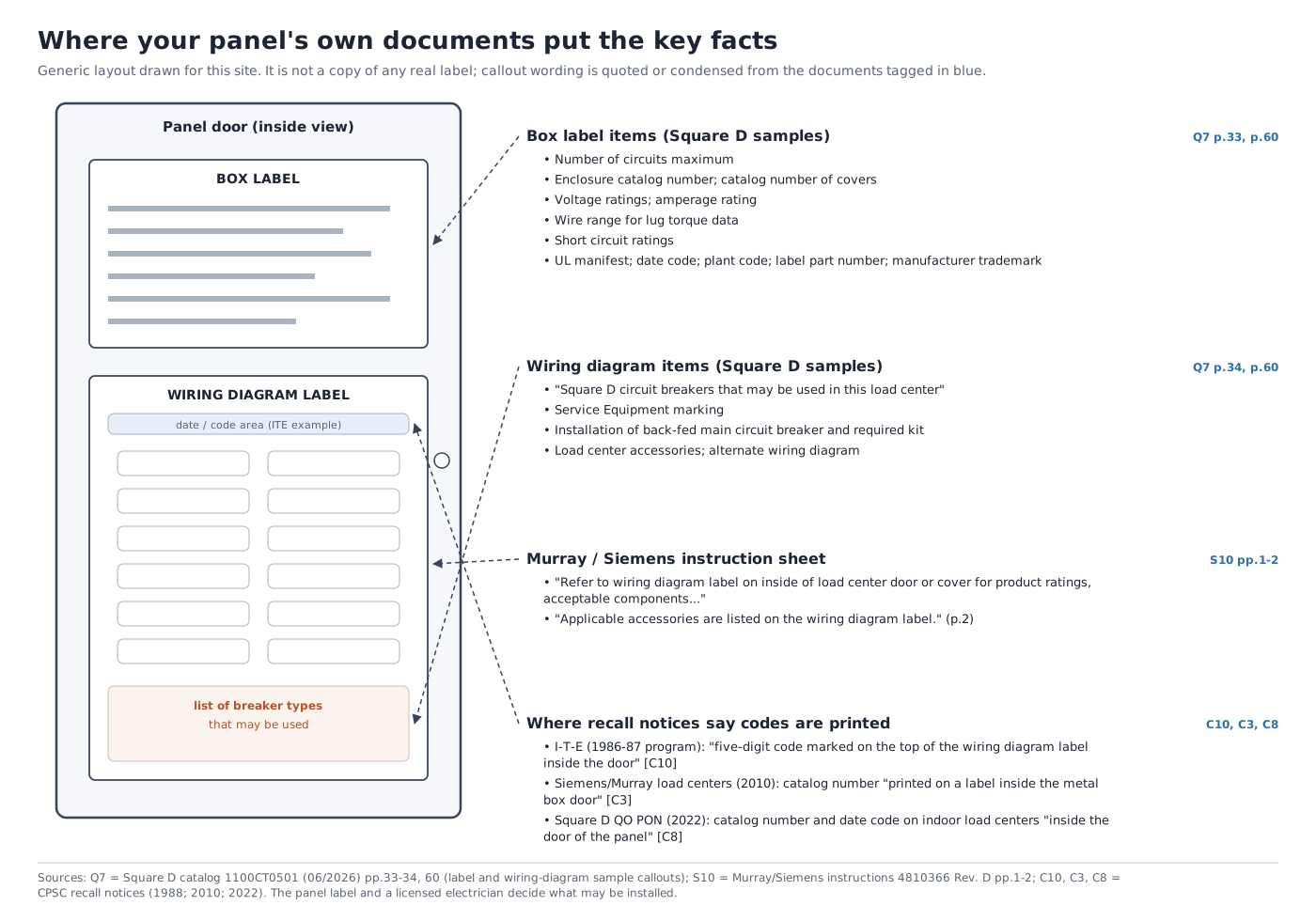
door of the panel" [C8]
Sources: Q7 = Square D catalog 1100CT0501 (06/2026) pp.33-34, 60 (label and wiring-diagram sample callouts); S10 = Murray/Siemens instructions 4810366 Rev. D pp.1-2; C10, C3, C8 =
CPSC recall notices (1988; 2010; 2022). The panel label and a licensed electrician decide what may be installed.
The code question: NEC 110.3(B)
- Eaton states that Classified Circuit Breakers "comply with the National Electrical Code (NEC) Section 110.3(B) Installation and Use" [E4 p.1].
- UL told inspectors that if the compatibility list is not provided with each Classified breaker, "the AHJ will not be able to determine compliance in accordance with NEC Section 110-3(B)" [U2 p.16].
Where the parties disagree
| Position | Source |
|---|---|
| Square D: QO and Homeline load centers are listed to accept only Square D breakers; other manufacturers' breakers void the UL listing and warranty | [Q1] |
| Square D warranty: disclaims liability for "incompatible or UL® classified circuit breakers" | [Q4] |
| Eaton: Classified breakers are tested in the loadcenters they are listed for, witnessed by UL; "no internal design differences between Specified and Classified" | [E4 p.1] |
| Eaton: the Magnuson-Moss Warranty Act prevents a manufacturer from making its warranty contingent on using its own replacement parts, "so long as the third-party technology is safe" | [E4 p.2] |
We report these positions without deciding between them. For warranty questions, ask the panel manufacturer. For code compliance, ask your AHJ.
Which Classified lines exist (in our library)
| Classified line | Made by | For use in place of | Source |
|---|---|---|---|
| Type CL, CLGF, CLCAF and CLRP smart breakers [E12 p.V1-T1-103]; CLDF [E1 p.4] | Eaton | Listed breakers in specified Crouse-Hinds, GE, ITE/Siemens, Murray, Thomas & Betts and Square D Homeline panels | [E1 p.1, p.4] |
| Type CHQ / CHFQ (¾-inch) | Eaton | "Replacement Breakers for Square D Type QO Loadcenters" | [E2 p.V1-T1-102] [E3 p.3] |
| Type QD (¾-inch) | Siemens | Square D QO, in the load centers on its Panelboard Compatibility List | [S6 PDF p.39] [S4] |
| Type MSQ (¾-inch) | Murray (Siemens) | "UL Classified for use in specific Square D® load-centers in place of Square D® Type QO® circuit breakers"; S1: the Murray brand of circuit breakers "is being phased out" | [S6 PDF p.61] [S1 p.1] |
| Type TQ (3/4") | ABB | "3/4" UL Classified Circuit Breakers for use in *Square D **QO Load Centers." | [G4 p.1-57] |
| UBI series | Connecticut Electric | Obsolete panel lines; vendor says "Safety Agency Certified to UL489" | [CE1 PDF p.2] |
Square D says its own QO and Homeline breakers are not classified for competitors' panels [Q2] [Q3].
What UL's public database shows
- UL's public (abridged, no-login) Product iQ search for category code DIXF, run on 2026-11-15, returned five entries: four Eaton files (DIXF.E11713, E45310, E7819, E543328) and one Siemens Industry file (DIXF.E82615). UL names the category "Circuit Breakers, Molded Case, Certified for Use in Specified Equipment" [P1].
- The public profile for Eaton file DIXF.E543328 lists the model as "Classified molded case circuit breakers, Type BRS"; UL's guide information for the category requires a Product iQ account [P2].
- Siemens' general (DIVQ) listing E82615 names Types QP, QT, QD, QAF2, HQP and others as UL listed models [P3].
- Category DIUR: "Circuit Breakers, Molded Case and Circuit-breaker Enclosures for Use in Photovoltaic Systems" [P4].
Limits that apply to every Classified breaker
- 120/240 V ac or less, with available short-circuit current of 10 kA or less [U1 item 97] [E1 p.1].
- Eaton: "applications up to and including 120/240 volts, 225 ampere (A) panels" [E4 p.2].
- Eaton's list: not for series-rated systems with the listed panelboards; handle-tied breakers must be the same manufacturer and type [E1 p.1, p.4].
- Siemens QD: not series rated with Square D breakers or equipment [S6 PDF p.39].
Common confusions
- "Classified means not UL listed." UL describes breakers that are both [U1 item 98]. Siemens describes QD as "UL Classified and UL Listed" [S6 PDF p.39].
- "If it clips onto the bus, it's compatible." Classification is tied to the panel catalog numbers on the list and to the supply limits [U1 item 99].
- "Eaton CL works in Eaton BR panels too." Eaton says CL is not UL listed for BR loadcenters [K3].
- "Classified works in any panel of that brand." UL ties a Classified breaker to the panelboards named on its compatibility list [U1 item 99]; Eaton's list is organized by panel maker, with meter-center and panelboard catalog numbers [E1 pp.2–10].
FAQ
How do I know which panels a Classified breaker may go in? Read the compatibility list supplied with the breaker [U1 item 99] [U2 p.16]. Eaton publishes its CL list as IL00304001Y [E1].
Can I look it up on UL's website? Eaton says Classified listings are in UL's Product iQ database [E4 p.2]. We checked the public (no-login) version on 2026-11-15: a search for DIXF returned four Eaton files and one Siemens file [P1]. For which panels a breaker may go in, use the compatibility list supplied with the breaker [U1 item 99]. UL also gives a phone and e-mail contact for confirming a certification [P2].
Is a Classified breaker allowed by code? UL's inspector guidance ties compliance with NEC 110.3(B) to the compatibility list [U2 p.16]. Square D disputes use in its panels [Q1]. Your AHJ decides.
Does a Classified breaker void my panel warranty? Square D says the use of other manufacturers' breakers voids the UL listing and warranty of QO and Homeline load centers [Q1]; its residential warranty disclaims liability for "incompatible or UL® classified circuit breakers" [Q4]. Eaton cites the Magnuson-Moss Warranty Act [E4 p.2].
Are Classified breakers different inside? Eaton says there are no internal design differences between its Specified and Classified breakers [E4 p.1].
What is a UL Classified breaker? UL's marking guide says a Classified-only breaker is marked on the side "Classified for use only in specified panelboards where the available short-circuit current is 10 kA, 120/240 volts ac or less", and that the catalog numbers of those panelboards are in a publication provided with the breaker [U1 item 97]. A breaker can also be both Classified and Listed; its marking then covers both uses [U1 item 98].
What UL standards apply to these breakers? Eaton says its Classified breakers are tested to UL 489 (molded-case circuit breakers), UL 67SB (loadcenters and panelboards), UL 943 and UL 1699 [E4 p.2].
Sources
| ID | Publisher | Document / version | Link | Kind |
|---|---|---|---|---|
| E1 | Eaton | IL00304001Y, visible imprint "Revised September 2024" (p.10); hidden text layers also contain "Revised May 2024" and REV. 24/27 markers; PDF mod 2025-06-05, 10 pp | link | primary |
| E2 | Eaton | CA08100002E, Nov 2022 (PDF mod 2024-12-30), pp V1-T1-101..105 | link | primary |
| E3 | Eaton | BR003051EN (URL br003034en), July 2026, 4 pp | link | primary |
| E4 | Eaton | WP003005EN, May 2024, 2 pp | link | primary |
| E12 | Eaton | CA08100002E Volume 1 Residential and Light Commercial, November 2022, full 105 pp (PDF created 2022-11-02); captured 2026-11-15 | link | primary |
| K3 | Eaton Knowledge Hub | Article 000001492 "Can CL breakers be used in BR loadcenters?", printed 2026-11-15 | link | primary |
| S1 | Siemens Industry (copy linked from the Siemens Sandy FAQ page S3) | letter dated 2019-09-05, 2 pp | link | primary-mirror |
| S4 | Siemens (cache.industry.siemens.com) | SIE_BR_QD (PDF mod 1999-06-05), 2 pp | link | primary |
| S6 | Siemens Industry | SPEEDFAX 2017 Section 1 Load Centers & Circuit Breakers (PDF mod 2020-02-13), 66 pp | link | primary |
| Q1 | Schneider Electric / Square D | FAQ FA109246, fetched 2026-11-15 | link | primary |
| Q2 | Schneider Electric / Square D | FAQ FA129931, fetched 2026-11-15 | link | primary |
| Q3 | Schneider Electric / Square D | FAQ FA124299, fetched 2026-11-15 | link | primary |
| Q4 | Schneider Electric / Square D | Data bulletin 0700DB2001 (PDF mod 2020-07-24), 2 pp | link | primary |
| G4 | ABB Electrification US | BuyLog Section 1 "Load centers, meter combos, and residential circuit breakers", document 9AKK108467A9432, "Section Updated 09/2026" (p.1-3), 72 pp; printed page 1-N = PDF page N; captured 2026-11-16 | link | primary |
| U1 | UL Solutions | MCCB Marking and Application Guide (web), fetched 2026-11-15 | link | primary |
| U2 | UL / IAEI Western Section | Report on UL-IAEI 2002 meetings (PDF mod 2003-08-29), 34 pp | link | primary |
| P1 | UL Solutions Product iQ (abridged, no login) | Search "DIXF", captured 2026-11-15 | link | primary |
| P2 | UL Solutions Product iQ (abridged, no login) | Profile DIXF.E543328, captured 2026-11-15 | link | primary |
| P3 | UL Solutions Product iQ (abridged, no login) | Profile DIVQ.E82615, captured 2026-11-15 | link | primary |
| P4 | UL Solutions Product iQ (abridged, no login) | Search "DIUR", captured 2026-11-15 | link | primary |
| CE1 | Connecticut Electric | 2017 catalog (PDF mod 2017-09-12), 32 pp | link | primary (vendor) |
All documents fetched 2026-11-15 or 2026-11-16 and archived with SHA256 (see SOURCE-LIBRARY.csv). Kind: primary = issued by the manufacturer/agency; primary-mirror = manufacturer document hosted by a third party.
Related reference photographs
Photo credit and licence
"220v service panel.jpg" by Kristoferb, licensed CC BY-SA 3.0 (https://creativecommons.org/licenses/by-sa/3.0), via Wikimedia Commons: https://commons.wikimedia.org/wiki/File:220v_service_panel.jpg Resized for the web.
Original Commons file and licenceKeep the reference with your question.
Retain the exact identifier, document revision, page and unresolved conditions. The lookup covers only one Eaton list; a result is not an equipment or installation assessment.
Search Eaton’s document Record a source discrepancy